
From Problem 3.9 Eqn 4, we already know that the field due to a ring of radius R with charge q at a distance x along its axis is given by,

Hence the electric field due to the two rings is given by,

For
 , we can use Taylor's series with l as the variable around zero and approximate the electric field as,
When
 the electric field becomes,
We also know that the potential due to a ring of radius R with charge q at a distance x along the axis is given by,
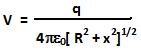
Hence, the potential due to the two rings is given by,

For
, we can use Taylor's series with l as the variable around zero and approximate the potential as,


