Sunday, May 16, 2010

Irodov Problem 3.38


a) Consider an infinitesimally thin spherical shell of thickness dr and radius r concentric with the charged sphere. The volume of this spherical shell will be . The charge density in the sphere is given by,


Hence the charge contained in this infinitesimally thin spherical shell is given by,


The electric potential due to this shell at the center of the sphere will then be,


b)

As derived in Problem 3.28 Eqn 2a, the electric field inside the sphere is given by,


The potential difference between a point that is at a distance r from the center within the sphere and the center can then be computed as,


Thus the potential at a distance r from the center is given by,

Irodov Problem 3.37

Similar to problem 3.34 we have,


An equipotential surface is a surface over which the electric potential is exactly the same value. For example the equipotential surface around a point charge is a sphere. Here the equation of the surface is given by,


We know that the equation of the circle is given by,


where r is the radius of the circle. In other words we can generate the surface in (1) by simply staking circles on top of each other along the z-axis where the radii of these circles is given by ,


In other words, if you take the curve,


in the x-z plane and rotate it about the z-axis a complete circle we will obtain the surface in (1). This is shown in the figure.


From basic conic sections we know that (3) results in either an ellipse or a hyperbola depending on the sign of b. Hence, by rotating these we would either get an ellipsoid or a hyperboloid.

Irodov Problem 3.36

This problem is similar to 3.35. Here we have,

a)


b)

Irodov Problem 3.35

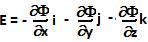
Electric field and electric potential are related as,


Here,is the gradient operator and represents the direction and magnitude slope of the electric potential in 3 dimensions. In Cartesian coordinates it is given by,


Thus,


For this problem,